

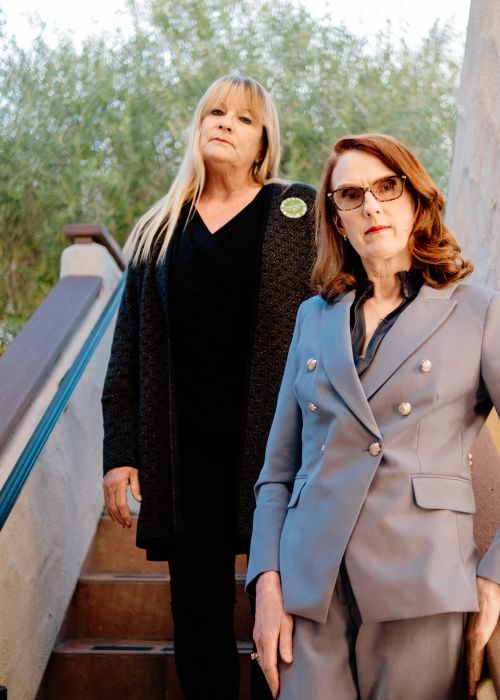

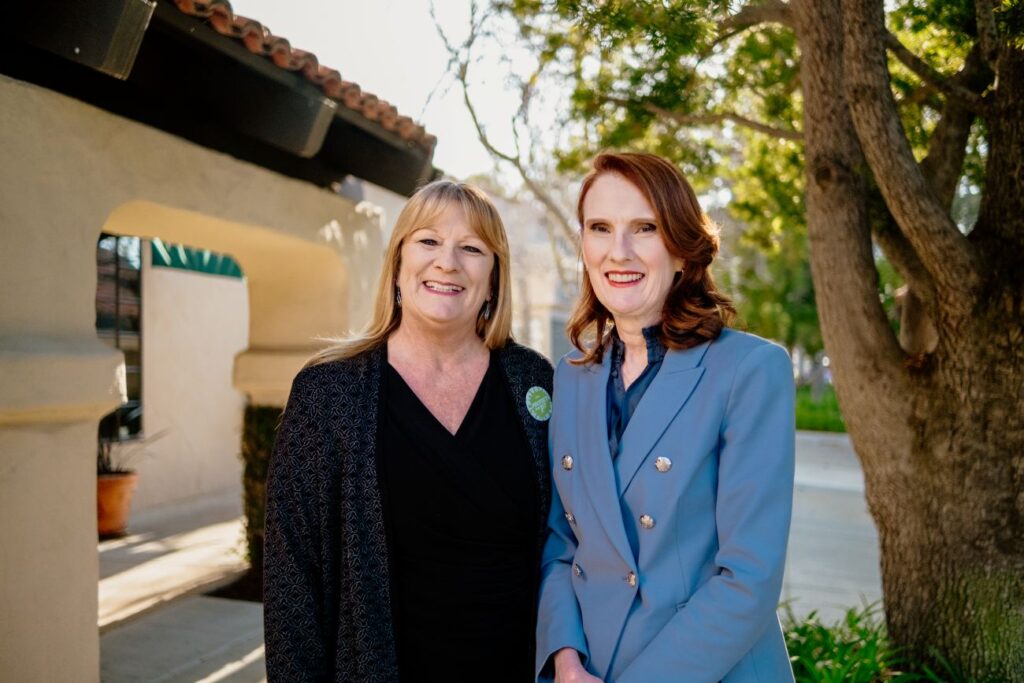
When seventh-grade English teacher Elizabeth Mirabelli received new district training materials in late 2021, she realized her job description had changed in a way she could not accept.
The Escondido Union School District in San Diego County had issued a policy that would soon become known as a “Parental Exclusion Policy.” It instructed staff to affirm a student’s “gender identity” at school while withholding that information from the child’s parents. Teachers were told to use a student’s new chosen name and pronouns in class but to switch back to the legal name and biological pronouns when speaking with family.

The materials Mirabelli received went further. The district explicitly stated that “parents or caretakers” were individuals who “do not have a legitimate need for the information,” regardless of a student’s age or circumstances. If a parent asked directly whether their child had begun using a different name or pronoun, teachers were instructed to deflect.
The script given to staff instructed them to tell parents that the “inquiry is outside of the scope” of discussion and to limit the conversation to “information regarding the student’s behavior as it relates to school, class rules, and assignments.” Even when a parent discovered the child’s name and pronoun change and objected, teachers were forbidden from honoring the parent’s wishes. The policy stated that a parent “is not allowed to override a student’s request for different pronouns or alternate names.”
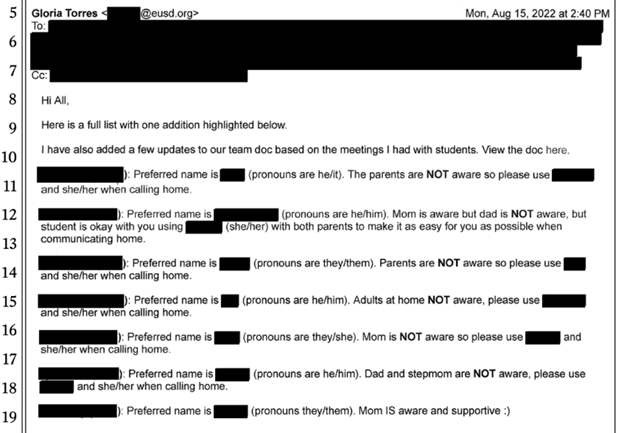
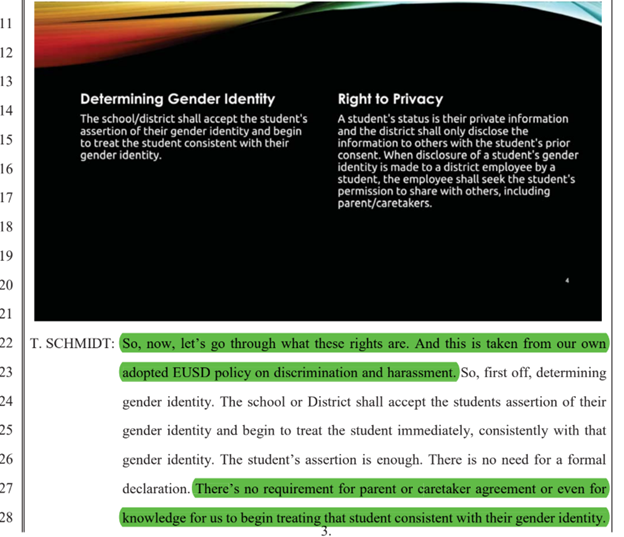
Escondido Union School District’s policy directed teachers to adopt a position of complete affirmation when a student declared a new “gender identity.” The district’s written instruction stated that “all elementary and middle school teachers must unhesitatingly accept a child’s assertion of a transgender or gender diverse identity” and “begin to treat the student immediately” according to that asserted identity. The policy emphasized that there was “no requirement for parent or caretaker agreement or even for knowledge,” and added, “There is absolutely no room for discussion, polite disagreement, or even questioning whether the child is sincere or acting on a whim.”
Mirabelli, a 25-year veteran who had been named Teacher of the Year and held national certification, could not reconcile those instructions with her conscience.
“Deceiving parents is wholly unacceptable,” she wrote in a formal accommodation request to school officials.
Her colleague, physical education teacher Lori Ann West, felt the same. West, a two-time Teacher of the Year and devout Christian, had taught in the same district for nearly 30 years.
Together, the two women asked to be exempted from the policy, and were flatly denied.
In a sworn declaration filed in federal court, Mirabelli said she was “surprised and shocked” by the district’s policy, and explained that it was the “first time in my 20 year teaching career that a policy directly conflicted with my sincerely held beliefs.” She added that she was “required, per protocol, to go along with the charade” because it was “required by the State.”
Paul M. Jonna, Special Counsel for Thomas More Society representing the teachers said the policies were “drafted by special interest groups and political ideologues” and were adopted in many districts “in secret during the pandemic,” bypassing parents completely. “These policies disregard the constitutional rights of parents and teachers,” he said.
Both teachers saw the directive as a violation of their religious and constitutional rights. Mirabelli, a devout Catholic, believes that God created human beings as male and female and that lying is morally wrong. She also believes that parents are entrusted by God with the primary duty to guide their children’s moral and emotional development. West shares those beliefs. She told attorneys that her Christian faith requires honesty and recognizes the parent-child relationship as sacred.
In April 2023, the two women filed a verified complaint in federal court, represented by Chuck LiMandri & Paul Jonna and the Thomas More Society. Their lawsuit, Mirabelli v. Olson, alleges that the Escondido policy violates both the Fourteenth Amendment right of parents to direct the upbringing and care of their children and the First Amendment rights of teachers to free speech and free exercise of religion.
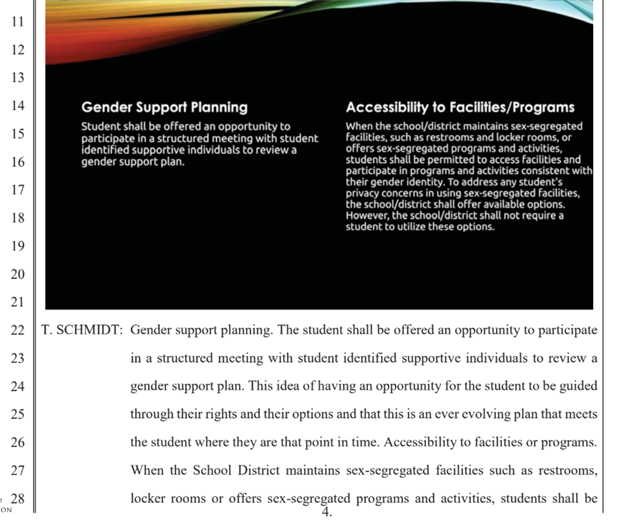
The complaint details how the secrecy policy works in practice. District materials describe a “Gender Support Plan” that may be created for a child without parental knowledge, noting that “there’s no requirement for parent or caretaker agreement or even for knowledge.” If a student requests a new identity, teachers must “begin to treat the student immediately” according to the asserted gender. Parents cannot be notified, and teachers who reveal the change to family members risk discipline.
“Teachers were being compelled to lie,” Jonna said. “They were told to use one identity at school and another at home. Judge Benitez already found these policies constitute a ‘trifecta of harm’ — violating the rights of parents, teachers, and students.”
In March 2023, a guest teacher was handling Mirabelli’s classes due to her absence. During Period 7, one trans-identified student (female-to-male) received a call slip to go home early. That call slip had the student’s legal name and the guest teacher read it in front of the class. Many students then immediately erupted in anger at the guest teacher, yelling: “That is not his name—it’s [redacted].”
The guest teacher was very shaken by the reaction and quickly apologized, saying she did not know the student’s preferred names. Apparently, some students then reported the uproar to the administrative office and the guest teacher received a call from an assistant principal seeking an explanation.
The document also examines the broader risks to children. The plaintiffs cite evidence that many minors who express gender confusion also experience other mental health challenges. One cited study found that 87.7 percent of children and adolescents diagnosed with gender dysphoria had additional psychiatric diagnoses, including anxiety, depression, and prior self-harm. The complaint argues that removing parents from the process prevents early intervention and increases the risk of harm.
The plaintiffs’ attorneys describe the school district’s approach as dangerous, not just unconstitutional.
“Public schools should never hide information from or lie to parents about a child’s mental health or personal circumstances,” the filing states.
The complaint also points to Supreme Court precedent, including Troxel v. Granville (2000) and Pierce v. Society of Sisters (1925), emphasizing that parents have a fundamental right to make medical and educational decisions for their children. By classifying parents as outsiders, Escondidot effectively displaced the family’s role and gave the state authority over the most personal aspects of a child’s identity.
For Elizabeth Mirabelli and Lori West, the conflict is also about compelled speech. The complaint argues that forcing teachers to use language that violates their beliefs constitutes government-mandated expression. It cites West Virginia State Board of Education v. Barnette (1943), which held that no official can “prescribe what shall be orthodox in politics, nationalism, religion, or other matters of opinion” or compel citizens to affirm it. The teachers say that being ordered to lie about biological reality or conceal the truth from parents compels them to voice ideas they reject.
The case also addresses religious liberty. The complaint quotes guidance from the Vatican’s Congregation for Catholic Education emphasizing that teachers must not preempt the role of parents and must respect “the physiological and psychological specificity of young people” while helping them mature in a healthy and responsible way. According to their attorneys, the district’s refusal to grant even a limited accommodation shows hostility toward faith-based conscience rights.
The policy’s reach extends far beyond one district. Similar gender secrecy policies have been adopted in dozens of California school systems under state guidance. The complaint names both Escondido Union School District and California education officials, including Superintendent of Public Instruction Tony Thurmond and members of the State Board of Education, as defendants. The plaintiffs argue that the state’s model policies have created a uniform system of parental exclusion across California’s public schools.
On October 15, 2025, a federal judge certified the case as a class action for all parents and teachers opposing California’s gender secrecy rules. The lawsuit against “Parental Exclusion Policies” will move forward on behalf of more than 300,000 California public school teachers and the parents of more than 5 million public school students. In a scheduled summary judgment hearing on November 17, 2025, Judge Benitez will consider whether to rule definitively that California’s gender secrecy policies violate parents’ and teachers’ constitutional rights.
As the case moves forward, the outcome will reach far beyond two teachers in Escondido.
“This case could very well set national precedent,” Jonna noted. “These policies have infected schools across the U.S. The legal analysis here could help dismantle them nationwide.”
Indeed, the case could very well decide whether the state can compel educators to deceive families, and whether parents still have the final say in their children’s care and religious freedom.